
Lawn mowing as aerobic exercise?

Image

I actually like don’t mind mowing my lawn.  I have a battery-powered push mower called a Neuton, which I push around my 1/4 acre, using one battery for the front lawn, and a second battery for the back lawn plus the “back forty”….  a rough forested patch out back. I never quite understood why so many of my neighbors ride on riding mowers when mowing their tiny lawns. But, to be fair, the Neuton will never win the Tim Allen Home Improvement Award for Rugged Manliness Woof! Woof! It has a nineteen-inch swath, and it takes a lot of back-and-forth to get the lawn done. It does a really nice job, doesn’t involve gasoline, runs really quietly and so is probably more ecological. I used to have the only one on my street, but since then a couple neighbors have bought them as well.

Occasionally I’ll wear a Polar heart rate monitor, and attempt to stay within a fat burning zone calculated any number of ways. Here’s an example for a forty year old person.

Resting Heart Rate = 60 (Taken before getting out of bed on multiple mornings)

Maximum Heart Rate = 220 – Age = 180

Heart Rate Reserve = Max – Resting = 120

The fat burning rate is 50% – 75% of the reserve; 60 – 90 beats added to the resting rate which suggests a range of 120 to 150.

Using the heart-rate monitor you can accurately modulate your heart rate by pushing faster or slower. I find that I have to usually slow down. The combination of concentrating on the heart rate and pushing slowly seems to induce a meditative state while mowing. (No really…)

Unfortunately, the fat-burning zone idea may be a myth. One argument is that if you push the lawn mower at a higher intensity, you’ll simply burn more calories, and a burned fat calorie is worth the same as burned glycogen (carb) calorie. So, maybe I should push harder, past the 75% range, which in the example would mean 150 beats or above.   Here’s another take, which is pretty convincing, which just goes to show how you can probably find a study which supports almost any point of view.

Another measurement that I take is the number of steps, with a FitBit. The back lawn plus the “back forty”, takes about 6200 steps, or a bit under three miles of walking. If I plug this into the FitBit calorie counter, as “Mowing Lawn, Walking, Power Mower” I get 490 calories for an hour and a quarter.

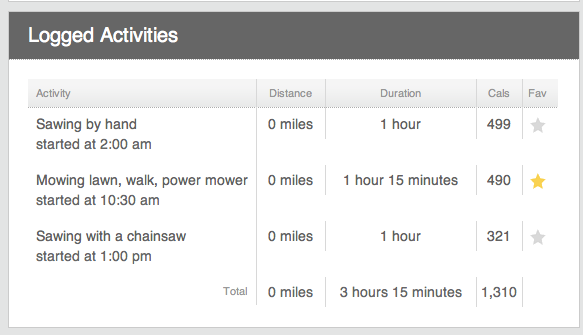
Then there is logging with a chain saw, one of the most strenuous and exhausting tasks that I know of, which leaves me sore for two days afterwards.  As an academic exercise, I put in an hour of chain sawing and an hour of hand-sawing. The FitBit calculator puts these in as 321 calories/hr and 499 calories/hr respectively.
Image

This seems to make less sense… I don’t quite see how gentle lawn mowing for an hour and quarter trumps an hour of chainsawing.
Tagged with: , , , , ,
Posted in Personal Technology, Sensors, Technology, Technology-Enabled Home

Parallax microMedic Kit Arrives

We used to do a “Christmas in July” day for our niece and nephew. Well, it looks like Christmas came in May to TFHHC… The Parallax microMedic contest kit has arrived. Among the most interesting components are: 

Universal Remote Control
4-Directional tilt Sensor
Polar WearLink Heart Rate Transmitter
Heart Rate Receiver
Color Sensor
Infrared Receiver
Infrared LED Assembly
10 Segment LED Bar Graph
4-Digit 7-segment LED display
Pressure Sensor
Handheld Nebulizer
Sp02 Finger Sensor

Tagged with: ,
Posted in Uncategorized

Develop iPad/iPhone Apps with Filemaker

FileMaker Pro from Apple is a desktop database development system, similar to Access. After developing a solution using the  desktop version (either Windows or Mac), you can deploy it on iOS devices, (iPad, iPad Mini, iPhone), sometimes with minimal changes. On iOS, your application is run using the free FileMaker Go runtime which is available from the Apple app store.

This FileMaker-to-iOS thing seems to be a well-kept secret. Although there are umpteen zillion apps on the app store, creating an app the usual way requires a fairly steep learning curve to develop with the iOS development kit and Objective-C programming language.

FileMaker shortens all that.

It could also be an attitude problem. People get scared hearing the word “database”, especially when talking about mobile applications. My friend and iOS guru Jesse Feiller,  suggests “Don’t say that FileMaker is a database that turns into an app. Say that your program is an app that has a data storage component. Virtually every useful program has to store data somehow.”

The FileMaker web site has a comprehensive case study of a company, Lee Medical, which provides contracted nursing services. If you look at the video, you can see the nurses updating their electronic medical record using an iPad from the car. Since the study says that data isn’t stored on the iPads themselves, it would follow that the iPads are using a 3G wireless connection to send data to the back-end database.

The FileMaker site also has a page of application suggestions for FileMaker Go.

I also have a couple posts on FileMaker on that other blog.

Tagged with: , ,
Posted in Technology-Enabled Home

Parallax microMedic Application Development Contest

Parallax, along with with the U.S. Army Telemedicine and Advanced Technology Research Center and Carnegie Mellon, are sponsoring the microMedic  contest for the use of vital-sign sensors for medical applications. Parallax has assembled a sensor and component kit targeted to Arduino or Propeller processors. The Arduino kit comes with a Board of Education shield for your own Arduino. The Propeller version of the kit comes with a Propeller Board of Education. There is a separate wireless sensor kit which includes XBee transceivers. Entry deadline is July 31, 2013.

Tagged with: , , ,
Posted in Personal Technology, Sensors, Technology, Technology-Enabled Home, Telemedicine, Wireless

Getting Nervous: Health Information Exchanges

Interesting discussion , “Risks” loom for health exchange technology about the software development for the Colorado Health Information Exchange by a group from the University of Colorado called Health Policy Solutions.

Colorado’s health exchange is supposed to debut in just six months, but having the technology ready by Oct. 1 may be an impossible task.
Critical problems threaten the system, ranging from a lack of coordination with the state’s technology office and historic problems with state IT systems to poor oversight by exchange managers and contractors and the potential for serious conflicts of interest among those charged with creating the complex multi-million dollar exchange system.

My question is why does it seem like everyone is doing their own thing? And if you read the article at the link above, and a companion article Tech Troubles Could Hobble Health Exchange it looks like the best-case scenario is that by the implementation deadline of October 1, Colorado will be running a version 1.0 system that has been cobbled together from multiple private vendors, with little oversight from the state’s IT staff.

In Vermont, we could be facing some of the same problems. One of the biggest it seems to me is the need for the HIE to serve as the translation hub for dozens of separate Electronic Medical Record systems.

Tagged with: , , ,
Posted in Electronic Health Record, Finance, Healthcare Reform

Dept. of Uphill Battles – The Hospital Charge Master

NPR’s Planet Money Team have a segment about Steven Brill who wrote the recent March 4, 2013 Time Magazine article about the lack of transparency in hospital billing.

“Obamacare will increase the risk for insurance companies, and therefore will increase premiums.”

“Medicare is the only place where you start to approximate a real market.”

The article, unfortunately, is now behind Time’s paywall, but there is considerable discussion about the article and its implications elsewhere on the web as well as letters to the editor.


Posted in Finance, Healthcare Reform

Dept. of Uphill Battles — Patient Portals.

Interesting article about Patient Portals suggested by Stephen Wilkins over on the LinkedIn Patient Engagement Group from Mind The Gap.

As the article describes, the portals can be pretty useless. I received the following after inquiring why my patient portal “MyHealthOnline” didn’t include a scheduled surgery and didn’t reflect a cancelled appointment, (so that I couldn’t rely on it for finding out the status of appointments).

I am writing in response to your questions regarding viewing appointments in MyHealth Online. Your scheduled surgery doesn’t appear because the physician advisory group that made the original configuration decisions for MyHealth Online decided that only a few appointment types would appear in MyHealth Online. These are “office visits” and “appointments.” So, at present, visit types of “outpatient procedures”, which is how your surgery was scheduled, are not appearing.You are not the first person to point out that it would be helpful to be able to view outpatient procedures as well. The two of us who administer the MyHealth Online application have suggested that we include more encounter types, but no decision has been made yet. As for the cancelled appointment with <primary care provider> on 5/3, the only way to tell that it has been cancelled is that it doesn’t appear in your list of upcoming appointments. Our scheduling system is a different vendor from our electronic medical record. Records are interfaced to our electronic medical record and from there to MyChart. Your full electronic record does indicate that the 5/3 office visit with <primary care provider> has been cancelled. Unfortunately, MyHealth Online doesn’t display as many details as the full medical record.

Also of interest:
1. the name of my primary care provider was spelled wrong (wrong last name altogether).
2. A password reset which was requested by phone was unable to be done because they had typed in the wrong eMail address. This couldn’t be rectified over the phone, even though I regularly receive phone calls to verify appointments, which presumably are HIPPAA compliant. They will have to send something via postal mail. This is the third or fourth time this was necessary.

I don’t want to sound cranky….but what’s the point?

Posted in Electronic Health Record

Dept. of Uphill Battles

In a post, Patient engagement will be tough task for health tech on InfoWorld http://bit.ly/ZpKCJh

As an example, I learned last week at the HIMMS 2013 conference that one pilot project of at-home wireless glucose monitors at several hospitals reduced readmission rates for diabetics between 19 and 65 percent, thus cutting care costs and reducing serious episodes of illness. But several hospitals discontinued the effort when the pilots were done because they saw their admissions decline, noted Dr. Wayne Guerra, a physician who relayed the findings at the conference.

Posted in Healthcare Reform, Personal Technology, Sensors, Technology, Telemedicine

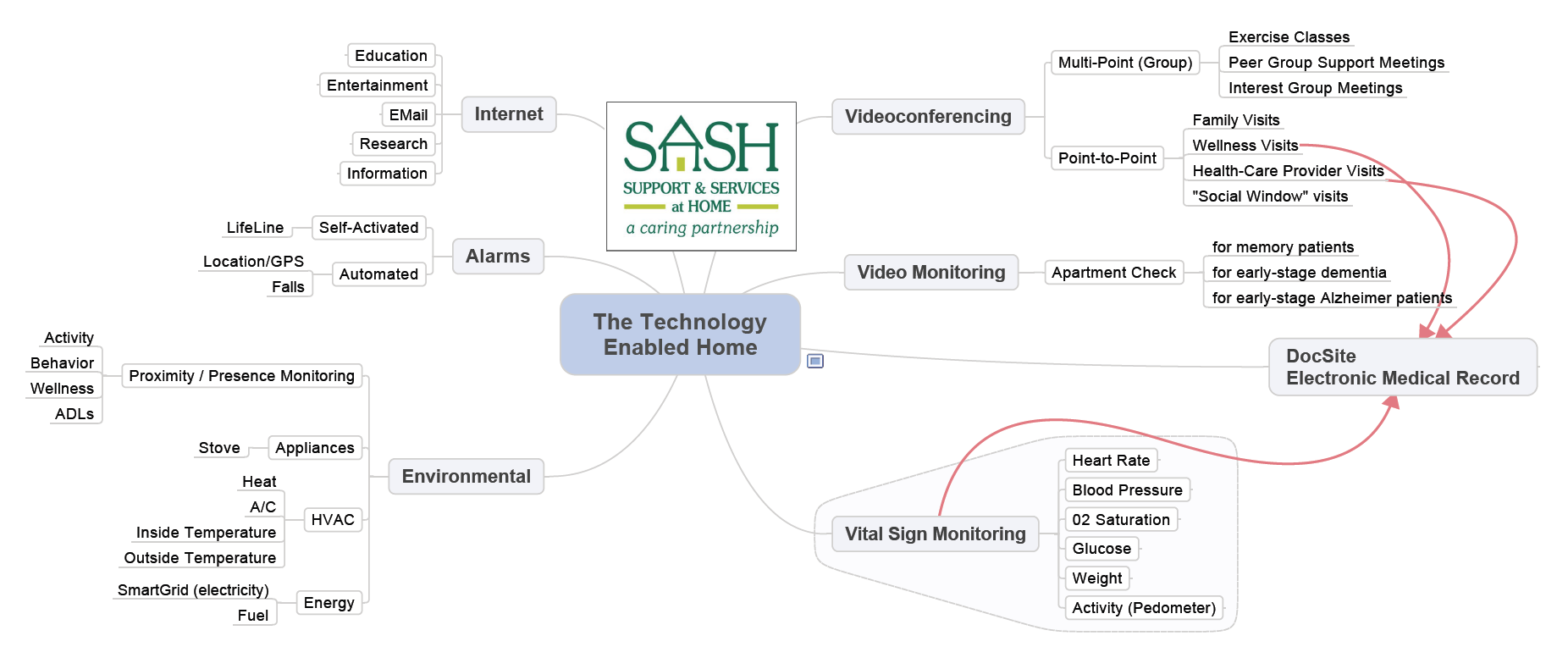
The Technology Enabled Home

“What would old people do with a fiber optic broadband internet connection to their home?”  (Click to enlarge the image).

Tagged with: , , ,
Posted in Electronic Health Record, Personal Technology, Sensors, Skype, Technology, Technology-Enabled Home, Telemedicine, Videoconferencing

The Technology Enabled Home: Applications and Bandwidth

I found myself building list of the applications that we would expect to be running in our rural senior housing sites, for both residents (The Technology Enabled Home) and the housing and health-care staff that are onsite. This should give us some ball-park ideas of what we might want for bandwidth to the building, and what we would expect to deliver to each apartment.

Infrastructure for Rural Housing Sites:
* Symmetrical bandwidth
* Office internet service for VoIP, Internet ,Videoconferencing for up to two simultaneous employees
* A minimum of two fixed IP addresses for the location.
* Wireless internet service in resident common areas
* Individual wired resident internet service in apartments for SASH (health care apps)
* Individual resident internet service for education, eMail, and consumer applications.
* Ubiquitous wireless throughout each building for iPad access (healthcare), and “casual” resident and guest service.

Applications for SASH and Property Management Staff
* H.323 videoconferencing (512Kb symmetrical) 
* VoIP for office lines
* VPN routing
* Property Management Database; (Boston Post)
* “Active” web applications (GoToMeeting, Skype, Skype Video, BaseCamp)
* EMR system (DocSite) requires continuous solid web connection)
* Streaming Video,  (Vimeo, YouTube)
* The usual web surfing,  eMail
* Cloud-based storage (DropBox,  Amazon S3)

* Vital sign sensor data (relatively low bandwidth)
* SmartGrid
* HVAC sensors and management
* Video monitoring / surveillance

Applications for Residents
* Web surfing, eMail
* Social Media: FaceBook, Twitter
* Skype,  Skype Video, FaceTime
* Video apps: YouTube, iTunes, Vimeo, Hulu
* Real-time networked gaming applications
* Tablet apps,  iPad, Kindle, etc.
* Tele-work applications 
Tagged with: , , , , ,
Posted in Electronic Health Record, Sensors, Skype, Technology, Technology-Enabled Home, Telemedicine, Videoconferencing, Wireless